
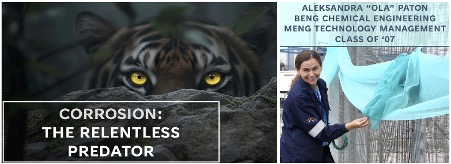
Join us for a hybrid (in-person and virtual) technical meeting on Wednesday 11 March 2026 at 18h00.
Our speaker will be Aleksandra “Ola” Paton (see Bio + Presentation Outline below) who will address us on the topic
“CORROSION – THE RELENTLESS PREDATOR”
For delegates attending in person:
Venue: Snape 3B Upper Campus University of Cape Town
Parking available outside the New Engineering Building.
An opportunity for networking with fellow professionals will follow the presentation.
REGISTRATION
If you wish to attend this meeting, please send an email to Ms Femmy Le Roux on
In the subject line put:
11 MAR - IN PERSON or
11 MAR – VIRTUAL
When you confirm virtual attendance a Teams meeting request will be sent to you.
DEADLINES for REGISTRATION
In person attendance – by 4 March 2026 (for catering purposes)
Virtual attendance – by 6 March 2026
THERE WILL BE NO CHARGE TO ATTEND THIS MEETING.
Speaker’s bio and an outline of the presentation:
ALEKSANDRA “OLA” PATON
BEng Chemical Engineering
MEng Technology Management
Aleksandra has experience in delivering complex, technology-intensive projects across the energy, mining, and chemical processing sectors.
With a strong foundation in energy optimisation, pyrometallurgy, gas-to-energy technologies, and chemical process design, she integrates deep technical insight with structured project execution to drive reliable, high-quality outcomes.
She specialises enabling disciplined yet agile engineering delivery.
Her experience spans full project lifecycles—from feasibility and conceptual development through detailed engineering, commercial structuring, and execution management. She is committed to advancing technical excellence and improving organisational delivery capability in all environments.
PRESENTATION OVERALL
IN ENGINEERING, WE OFTEN TALK ABOUT “MAINTAINABLE LIFE," BUT THAT TERM CAN BE A MASK FOR PLANNED OBSOLESCENCE — DESIGNING THINGS TO FAIL JUST SO THEY CAN BE REPLACED. WHEN DEALING WITH ACID CORROSION, THE STAKES OF THIS MINDSET SHIFT FROM BEING A MERE FINANCIAL ANNOYANCE TO A GLOBAL ETHICAL CRISIS.
CHOOSING A "CHEAP" OR "SHORT-TERM" PROTECTION METHOD IN AN ACIDIC ENVIRONMENT ISN'T JUST A BUDGET DECISION; IT’S A DECISION TO EVENTUALLY RELEASE TOXINS INTO THE SOIL, WASTE ENERGY ON EARLY REPLACEMENTS, AND CONSUME RARE RESOURCES TO REBUILD WHAT SHOULD HAVE LASTED.
AS A CHEMICAL ENGINEER, THE MORAL IMPERATIVE IS TO DESIGN FOR PERMANENCE AND CIRCULARITY. THIS MEANS MOVING BEYOND "HOW LITTLE CAN WE SPEND?" TO "HOW CAN WE ENSURE THIS NEVER LEAKS?"
LET'S BREAK DOWN THIS ETHICAL SHIFT INTO THREE KEY AREAS.
THE ENVIRONMENTAL DEBT: THE HIDDEN COST OF "CHEAP" MATERIALS—LEAKS, SPILLS, AND THE MASSIVE CARBON FOOTPRINT OF REPLACING HEAVY INFRASTRUCTURE.
PUBLIC SAFETY & TRUST: THE "SOCIAL CONTRACT" OF ENGINEERING—WHY A MICROSCOPIC PIT IN A CHEMICAL TANK IS A BETRAYAL OF THE COMMUNITY'S SAFETY.
RESOURCE STEWARDSHIP: HOW ADVANCED MATERIALS LIKE FLUOROPOLYMERS OR HIGH-NICKEL ALLOYS FIGHT THE "THROWAWAY CULTURE" OF MODERN INDUSTRY.
