South African Institution of Chemical Engineers

SAIChE

Proud Company Members

Image
Image
Image
Image

Events

sun
mon
tue
wed
thu
fri
sat


1
2
3
4
5
6
7
8
9
10
11
12
13
14
15
16
17
18
19
20
21
22
23
24
25
26
27
28
29
30
31
 
  • 15 Jul 16 Jul
    On-line Course: Design of Pumping Systems

    CPD 3 credits. CPD Ref. no: SAIChE-435 Provider: E4A (SAIChE-SPV-004)
    Includes numerous Sub-Courses such as Design for Friction Head and Piping-Pump Cost Optimization Models, NPSH Design, Design to avoid Cavitation and Recirculation, Pumps parallel and sequential layouts, Critical variables in Installation, Special Pump types, Vessel-Basics, Design of Drives, VSDs and PLCs, Design of Seals.
    Click for more info.

    Online
  • 22 Jul 23 Jul
    On-line Course: Design of Vessels, Tanks and Piping.

    CPD 3 credits. CPD no.: SAIChE-433 Provider: E4A (SAIChE-SPV-004)
    Includes numerous Sub-Courses such as 7 Tank Material Designs, Design with Corrosion Barrier Analyses, Temperature-Pressure Ratings in Designs, Design for Pressure and Vacuum Services, Major Cost Saving Design features, Unique Vessels including 3D Printed Vessels. A special overview of Roto-Moulded Tanks is provided. Piping design is at an introductory level.
    Click for more info.

    Online

On-line Course: Design of Pumping Systems

CPD online

15 JulyJuly
Online

CPD 3 credits. CPD Ref. no: SAIChE-435 Provider: E4A (SAIChE-SPV-004)

Includes numerous Sub-Courses such as Design for Friction Head and Piping-Pump Cost Optimization Models, NPSH Design, Design to avoid Cavitation and Recirculation, Pumps parallel and sequential layouts, Critical variables in Installation, Special Pump types, Vessel-Basics, Design of Drives, VSDs and PLCs, Design of Seals.

There are special detailed studies of total pump systems and the interfaces with pump and pipe designs. There are also guidelines on pump types and materials selections for capital cost and lifetime savings. The Pre, Mid and Post-Reading Files are also full of an outstanding bank of design and operational guidelines.

All courses of E4A are directed at practical application of the theories of each of the course main topics and thus the courses are introduced with a series of articles for pre-reading to provide an overview to each course and to broadly introduce the attendees to the subject matter. Notes and articles on pumping systems are also frequently added.  In this Course the importance of a total pumping systems approach is presented and emphasized and there is also extended consideration given to the many key and critical variables that are relevant to the design of pumping systems and thus the effectiveness of each design.

This popular, unique and information packed course enables those involved in design, projects and plant operations to analyse and design a range of pumping systems in greater detail – thus achieving more cost-efficient and effective complete engineering designs aligned with process requirements.
This course first provides overviews of the range of pumps available and then addresses all the technical points of pump design such as piping hydraulics, pump sizing, pump curves, NPSH and how a pump’s operation is reflected in the curves. A solid presentation of all pump design parameters including seals is presented.    

This Course focusses firstly on the fundamentals of materials with important coverage of materials used in pump and piping systems design as well as many important material grades, special terminologies and understanding key topics such as extruded versus welded pipe materials. The need to understand the rating of metals and non-metals for pressure and temperature variables is dealt with in detail to ensure a wide understanding of materials in engineering design. There are a range of materials shown in our chart and for total systems there are 12 major materials choices presented.

The Course then addresses unique and special pump types such as slurry pumps, plastic pumps, chemical service steel-shrouded pumps, chemical service sump pumps, diaphragm pumps and other services, such as magnetic-drive pumps. A range of interesting design options for a range of special processes. The assessment of pipe layouts and the conditions of the pump operation (such as water hammer, pump sparing and others) are followed through to a detailed selection of the pump for the relevant service. There are also some sub-courses that are always added such as bellows design and corrosion as materials selection parameters - to broaden the course and provide the full pump system design considerations.     

The final summary is prepared as a series of DESIGN STAGES OR STEPS in a master chart with control checklists, and the appropriate design standards, and design limitations are discussed and finalized. Interesting and unusual case studies are also presented. 

MAIN OBJECTIVES

The main objective is to develop skills of attendees to approach pump designs as a total systems design including upstream and downstream lines, total piping systems and control with VSD and PLC designs.

Economic benefits are firstly achieved through the evaluation of different materials and assessing the most suitable and thus effective materials for the given process variables, service and functional needs, and potential hazards. Economic benefits are secondly achieved through optimisation of the design and a deeper understanding of how design approaches and parameters can be leveraged to greater savings and profits, whilst not compromising any EHS considerations.

Attendee comments:
“This is a thorough and immersive Course. Thank you for the exciting course”, Emile R.;
The Course covered a broad spectrum of pump design and material selection and pump seals”, Carinee N.

Presenter: John Broli. (MD E4A) 
For more information or to make your booking, contact John Broli at This email address is being protected from spambots. You need JavaScript enabled to view it.

Cost 2026:
Registered Persons Fees/Rates are R6950 (+VAT) for the 2 Live on-line days and 1 private day CPD Courses. 3 CPDs.
Quantity discounts are available for group attendances or multiple bookings paid in advance.

Dates: 11-12 March 2026, 13-14 May 2026, 15-16 July 2026, 16-17 September 2026, 18-19 November 2026.

All courses include:
a. Interesting pre-reading material is sent to attendees normally 2 days prior to the start.
b. Full course materials are emailed ahead to you for the course and your personal library.
c. Videos links through ZOOM or Microsoft Teams still enable samples of products to be shown.
d. The Course framework/plan is sent to attendees as an Excel Document enabling easy tracking.
e. Workshops which include case studies and worked examples are interspersed with tea and lunch breaks and all materials are sent ahead to attendees for these exercises.
f. A Certificate of Attendance with CPD points reflected is provided at the end of the event.

On-line Course: Design of Vessels, Tanks and Piping.

CPD online

22 JulyJuly
Online

CPD 3 credits. CPD no.: SAIChE-433 Provider: E4A (SAIChE-SPV-004)

Includes numerous Sub-Courses such as 7 Tank Material Designs, Design with Corrosion Barrier Analyses, Temperature-Pressure Ratings in Designs, Design for Pressure and Vacuum Services, Major Cost Saving Design features, Unique Vessels including 3D Printed Vessels. A special overview of Roto-Moulded Tanks is provided. Piping design is at an introductory level.

There are very special studies of the US vs EU Standards and the Design Outcomes against different stress allowances. There is a full section on materials selections with vessels and consequent capital cost and lifetime savings. The Pre, Mid and Post-Reading Files are an outstanding bank of design, cost savings and operational guidelines.

The popular, unique and information packed course to enable those involved in design, projects and plant operations to analyse and design a range of process vessels, tanks and pipes in greater detail – thus achieving more cost-efficient and effective complete engineering designs aligned with each process requirement.

The vessel function and main design requirements are analysed through advanced needs, systems, scoping, information and risk analytical methods. Each of the main material types that can be applied in vessels designs are addressed in turn. Steels, Stainless Steels and Exotic Steels, Thermoplastics and Thermosets (Fibreglass), and Steel Plastic-lined Vessels are the main materials groupings evaluated (in total 12 materials types and combinations). Applicable standards are addressed for each material and the critical variables in total design are fully addressed. Pressure Vessels are also addressed in a special sub-section. Hazardous Processes are discussed, and attendees are introduced to the relevant design standards for hazards products.

Piping systems design introduces pipes as pressure vessels and the range of types evaluated matches the total 12 materials types and combinations discussed as vessels.

A section on installation and related topics is provided and there is guidance on vessel batch sizing, design for mixers and reactors, piping installation guidance and cautionaries with installations.
Much attention is paid to the importance of vessel design lifetimes with alternate materials.         
There is a supporting sub-course on Economics in Engineering Manufacture and Design with interesting examples of cost savings through understanding where leverage in design can be achieved.

The final summary of the Course that we present at the end of DAY 2 is prepared as a series of DESIGN STAGES OR STEPS in a master chart with control checklists, and the appropriate design standards and design limitations are discussed and finalized. Interesting and unusual case studies are also presented.

MAIN OBJECTIVES

The main objective is to develop skills of attendees to assess vessels, tanks and piping design as a total systems approach, and to evaluate a number of economically viable materials for each application. A range of competencies are enhanced including use of engineering design and contextual judgement, developing knowledge-based engineering problem-solving, and other key design practices.              

Economic benefits are firstly achieved through the evaluation of different materials and assessing the most suitable and thus effective materials given the critical variables such as pressure, temperature, corrosion, load bearing and other important system parameters.
Economic benefits are also achieved through optimisation of the design and a deeper understanding of how design approaches and parameters can be leveraged to greater savings and profits, while still within design standards and thus safe design parameters.

Attendee comments:
“Thanks for an excellent course”, Wikus P.
“Thanks for an interesting and excellent course”, Mark K.
“Great knowledge, very valuable”, Forrester de B;
“Course and information was very insightful, a very valuable course”, Channel D.  

Presenter: John Broli. (MD E4A) Tel: 082 786 8507.    

For more information or to make your booking, contact John Broli at This email address is being protected from spambots. You need JavaScript enabled to view it.

Cost 2026:
Registered Persons Fees/Rates are R6950 (+VAT) for the 2 Live on-line days and 1 private day CPD Courses. 3 CPDs.
Quantity discounts are available for group attendances or multiple bookings paid in advance.

Dates: 4-5 February 2026 / 8-9 April 2026 / 22-23 July 2026 / 9-10 September 2026 

All courses include:
a. Interesting pre-reading material is sent to attendees normally 2 days prior to the start.
b. Full course materials are emailed ahead to you for the course and your personal library.
c. Videos links through ZOOM or Microsoft Teams still enable samples of products to be shown.
d. The Course framework/plan is sent to attendees as an Excel Document enabling easy tracking.
e. Workshops which include case studies and worked examples are interspersed with tea and lunch breaks and all materials are sent ahead to attendees for these exercises.
f. A Certificate of Attendance with CPD points reflected is provided at the end of the event.

SAIChE news

May 13, 2026

KZN Webinar: Electrons + Molecules: The Future Grid Needs Flexibility

in KwaZulu-Natal

A webinar was held by the KZN branch on Friday, 29th May 2026 at 15h00. The speaker was Udhir Debising who addressed us on the…
May 01, 2026

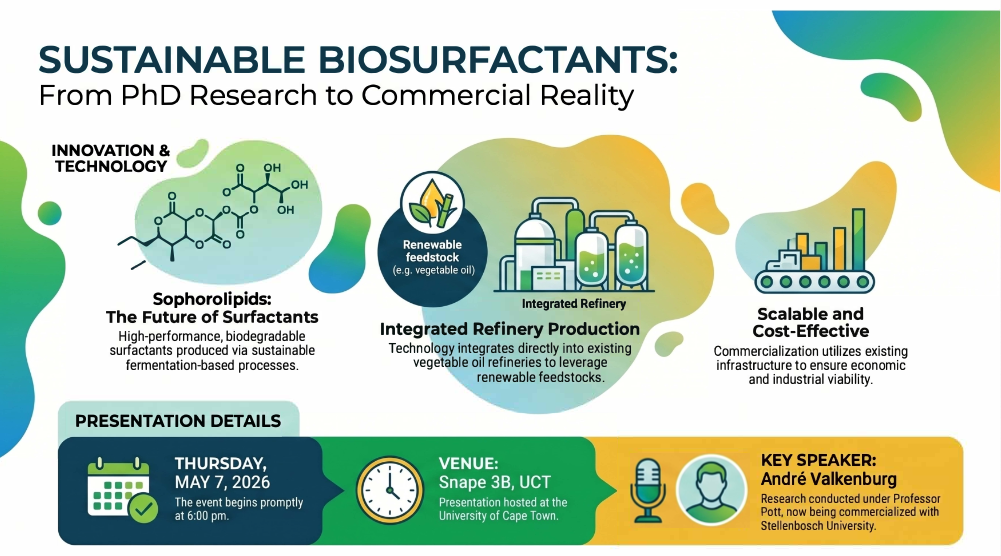
WC Branch: Sustainable Biosurfactants - PhD Research to Commercial Reality

in Western Cape

The recent presentation by André Valkenburg, held on May 7, 2026, at 6 pm at UCT’s Snape 3C and via the online stream, was a…
April 22, 2026

SAIChE ANNUAL GENERAL MEETING - 21 MAY 2026

in SAIChE news

On 21 May 2026 (6 to 7pm) SAIChE held its 2026 AGM online. Thank you to the members who joined in. We value your support!…
Image
© 2022 SAIChE. All Rights Reserved
Design & Developed by Parsley Studios