
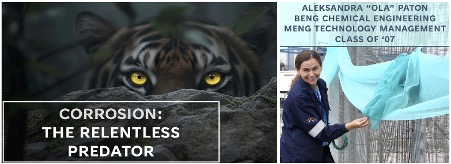
On Wednesday 11 March 2026, the South African Institution of Chemical Engineers hosted an engaging and insightful presentation by Aleksandra “Ola” Paton titled “Corrosion: The Relentless Predator.”
The talk brought together students, academics, and industry professionals to explore corrosion not only as a technical challenge, but as an ethical and sustainability issue facing modern engineering.
Paton, who holds a BEng in Chemical Engineering and an MEng in Technology Management, has extensive experience delivering complex projects across the energy, mining, and chemical processing sectors. Drawing on her background in energy optimisation, pyrometallurgy, gas-to-energy technologies, and chemical process design, she provided a compelling perspective on how corrosion impacts the entire lifecycle of industrial infrastructure.
A central theme of the presentation was the need to rethink the concept of “maintainable life.” While often framed as a practical design consideration, Paton argued that it can sometimes mask a culture of planned obsolescence. In corrosive environments—particularly acidic systems—short-term material or protection choices can lead to long-term consequences, including environmental contamination, increased carbon footprint from repeated replacements, and unnecessary consumption of scarce resources.
One of the most thought-provoking insights was the proposal to explicitly incorporate chemical degradation mechanisms into process safety studies such as Hazard and Operability Study. Considering corrosion chemistry within these structured risk assessments can help engineers anticipate long-term integrity issues and design systems that prioritise permanence and safety.
The discussion also explored broader engineering responsibilities, including environmental stewardship, public safety, and maintaining the social trust placed in engineers. By highlighting advanced materials and long-term design strategies, the talk encouraged a shift from the question “How little can we spend?” to “How can we ensure this system never leaks?”
For students in attendance, the presentation provided a valuable connection between classroom concepts and real-world engineering practice, reinforcing the importance of sound design principles and ethical decision-making in professional life.
The event sparked lively discussion and left attendees with a renewed appreciation for the role chemical engineers play in designing infrastructure that is not only functional, but responsible and sustainable.
Speaker’s bio and an outline of the presentation:
ALEKSANDRA “OLA” PATON
BEng Chemical Engineering
MEng Technology Management
Aleksandra has experience in delivering complex, technology-intensive projects across the energy, mining, and chemical processing sectors.
With a strong foundation in energy optimisation, pyrometallurgy, gas-to-energy technologies, and chemical process design, she integrates deep technical insight with structured project execution to drive reliable, high-quality outcomes.
She specialises enabling disciplined yet agile engineering delivery.
Her experience spans full project lifecycles—from feasibility and conceptual development through detailed engineering, commercial structuring, and execution management. She is committed to advancing technical excellence and improving organisational delivery capability in all environments.
PRESENTATION OVERALL
IN ENGINEERING, WE OFTEN TALK ABOUT “MAINTAINABLE LIFE," BUT THAT TERM CAN BE A MASK FOR PLANNED OBSOLESCENCE — DESIGNING THINGS TO FAIL JUST SO THEY CAN BE REPLACED. WHEN DEALING WITH ACID CORROSION, THE STAKES OF THIS MINDSET SHIFT FROM BEING A MERE FINANCIAL ANNOYANCE TO A GLOBAL ETHICAL CRISIS.
CHOOSING A "CHEAP" OR "SHORT-TERM" PROTECTION METHOD IN AN ACIDIC ENVIRONMENT ISN'T JUST A BUDGET DECISION; IT’S A DECISION TO EVENTUALLY RELEASE TOXINS INTO THE SOIL, WASTE ENERGY ON EARLY REPLACEMENTS, AND CONSUME RARE RESOURCES TO REBUILD WHAT SHOULD HAVE LASTED.
AS A CHEMICAL ENGINEER, THE MORAL IMPERATIVE IS TO DESIGN FOR PERMANENCE AND CIRCULARITY. THIS MEANS MOVING BEYOND "HOW LITTLE CAN WE SPEND?" TO "HOW CAN WE ENSURE THIS NEVER LEAKS?"
LET'S BREAK DOWN THIS ETHICAL SHIFT INTO THREE KEY AREAS.
THE ENVIRONMENTAL DEBT: THE HIDDEN COST OF "CHEAP" MATERIALS—LEAKS, SPILLS, AND THE MASSIVE CARBON FOOTPRINT OF REPLACING HEAVY INFRASTRUCTURE.
PUBLIC SAFETY & TRUST: THE "SOCIAL CONTRACT" OF ENGINEERING—WHY A MICROSCOPIC PIT IN A CHEMICAL TANK IS A BETRAYAL OF THE COMMUNITY'S SAFETY.
RESOURCE STEWARDSHIP: HOW ADVANCED MATERIALS LIKE FLUOROPOLYMERS OR HIGH-NICKEL ALLOYS FIGHT THE "THROWAWAY CULTURE" OF MODERN INDUSTRY.
